
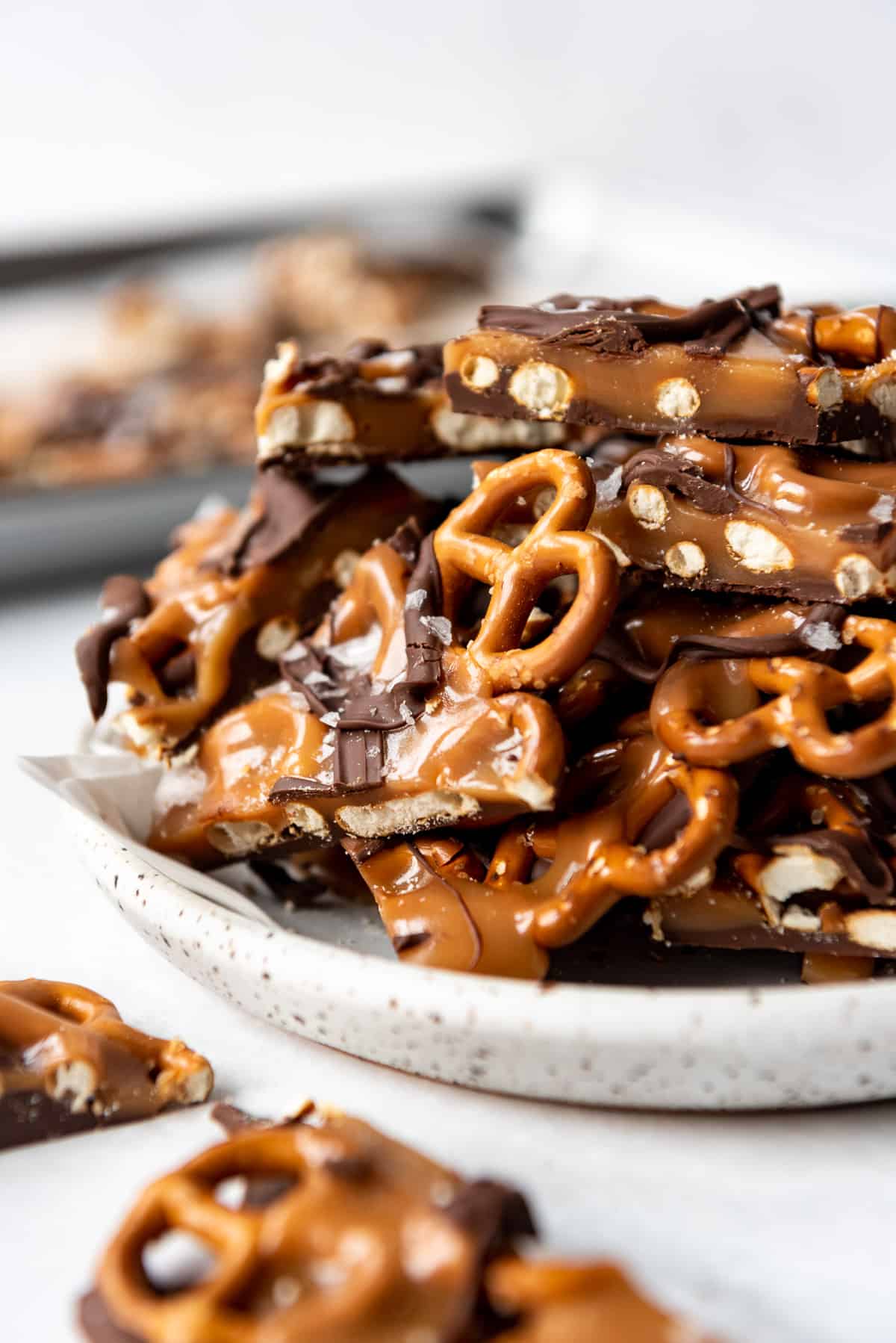
Ingredients I use
Caramel
- 1 cup granulated sugar (200 g)
- 1 cup heavy cream, divided
- 1/2 cup light corn syrup
- 6 tablespoons salted butter, cubed (85 g)
- 1/4 teaspoon salt
- 1 teaspoon vanilla extract
Pretzel bark
- 3 cups semisweet chocolate chips (about 18 oz)
- 2 teaspoons coconut oil
- 8 ounces pretzel twists (about half of a regular 16‑oz bag)
- Flaky Maldon salt or sea salt, for sprinkling
I use a heavy‑bottomed saucepan and a candy thermometer for the caramel so I can hit the right temperatures without guessing. I like semisweet chocolate chips for balance, but any good dark chocolate works. Coconut oil helps thin and gloss the chocolate so it spreads and drizzles smoothly.
How I make Chocolate Caramel Pretzel Bark
I cook the caramel
I start by setting up a parchment‑lined baking sheet for the bark so it’s ready when the caramel is done. In a medium heavy‑bottomed saucepan over medium‑low heat, I combine the granulated sugar, 1/2 cup of the heavy cream, light corn syrup, cubed salted butter, and salt. I cook and stir until the butter is completely melted and the mixture is smooth, keeping the heat gentle and resisting the urge to rush it.
Once the butter has melted, I stop stirring and increase the heat just to medium to bring the caramel to a gentle simmer, not a rolling boil. I clip a candy thermometer to the side of the pan, making sure the tip is submerged but not touching the bottom. I let the mixture cook without stirring on medium‑low to medium heat until it reaches about 236°F (soft‑ball stage). The bubbles will be steady, and the color will deepen slightly.
When the caramel reaches 236°F, I carefully pour in the remaining 1/2 cup of cream. The temperature drops at first, but it comes back up quickly as it returns to a simmer. I keep cooking without stirring until the thermometer reads between 245°F and 248°F. This is the sweet spot where the caramel sets chewy but not hard. I don’t crank the heat higher to speed this up, because that can scorch the sugar or push the caramel past the soft stage before I know it.
As soon as it hits 245–248°F, I remove the pan from the heat and stir in the vanilla extract. I let the caramel rest for about 10–15 minutes so it cools and thickens slightly before I pour it over the pretzels; if it’s too hot and thin, it can run everywhere instead of coating.
I melt the chocolate and assemble the base
While the caramel cools, I melt the chocolate. In a large microwave‑safe bowl, I combine the semisweet chocolate chips and coconut oil. I microwave in short 20–30 second bursts, stirring well after each one, until the chocolate is completely melted and smooth. If I’d rather, I can melt it gently in a double boiler on the stove.
I spread about 2/3 of the melted chocolate evenly over my parchment‑lined baking sheet, using an offset spatula to smooth it into a roughly even rectangle. I don’t worry about perfect edges; I just aim for a consistent thickness.
I add pretzels and caramel
I scatter the pretzel twists evenly over the still‑soft chocolate base, pressing them in gently so they adhere. It’s fine if they overlap a bit; that overlapping helps give the bark some height and interesting texture. I try to cover most of the chocolate foundation with pretzels so every piece of bark has some crunch.
Once the caramel has cooled and thickened a bit, I pour it evenly over the pretzels. I move slowly and use a spatula to encourage it into the gaps so the caramel touches as many pretzels as possible. The caramel is what really holds the bark together, so I like to make sure it flows around and between the pretzel twists.
I finish with more chocolate and salt
I drizzle the remaining melted chocolate over the top of the caramel and pretzels. Sometimes I just use a spoon and let it fall in zigzags; other times, I transfer the chocolate to a small plastic bag, snip off a corner, and pipe it in thinner lines for a more decorative look.
While the chocolate and caramel are still soft, I sprinkle a generous amount of flaky Maldon salt or sea salt over the surface. I don’t skimp on this step; the salt cuts through the sweetness and gives each bite those irresistible salty‑sweet pops.
I let the bark set and then cut it
I let the bark sit at room temperature until the caramel firms up and the chocolate is fully set. Depending on my kitchen, this can take about 2 hours. If I’m in a hurry, I slide the baking sheet into the fridge to speed things along.
Once everything is firm, I lift the bark off the baking sheet by the parchment and transfer it to a cutting board. I use a sharp knife to cut it into rough squares or shards, pressing straight down rather than sawing so I don’t shatter too many pieces. The jagged edges and different sizes are part of the charm.
Continue to the next page to reveal more tips and tricks